We use cookies to make your experience better. To comply with the new e-Privacy directive, we need to ask for your consent to set the cookies. Learn more.

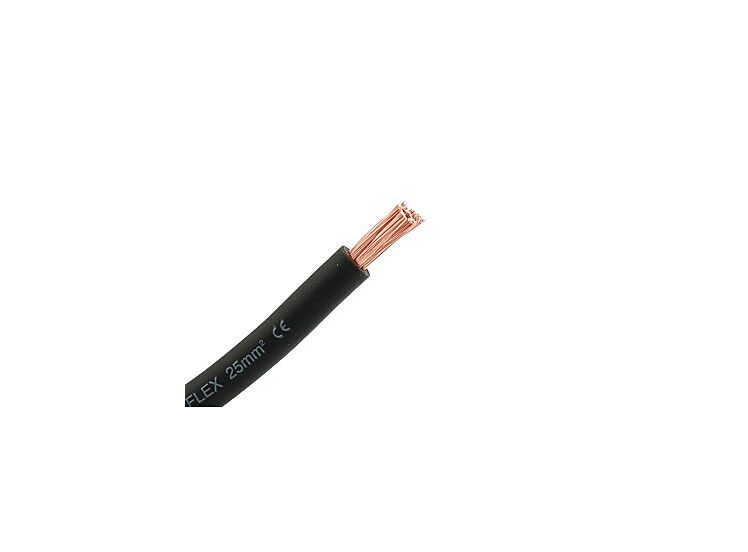
BAS - Battery cable 25mm² black - p/m
SKU:
BAS25BLACK
Details
Battery cable 25mm² black.
We only supply full meters. If you order more than 1 meter, you will receive it in one piece; for example, if you order 20 meters, you will receive 20 meters in one piece. Please indicate above how many meters you would like to order.
The 25mm² battery cable is a versatile and flexible cable with many applications. This 25mm² battery cable has a PVC compound insulation sheath that offers flexible properties. The insulation sheath complies with the IEC 60332-1 standard for fire safety; the hardness of the insulation sheath is 70±5 Shore "A," which protects the cable against chafing, rattling, etc.
The 25mm² battery cable is manufactured in accordance with the following standards: IEC 332-1/CEI EN 50265. The combination of insulation and the multi-core structure of the battery cable makes it a flexible product. This cable is suitable for use with voltages up to 600V. However, 12V or 24V are the most commonly used voltages.
25mm² Battery Cable Specifications:
- Main Color - Black
- Cable Thickness - 25.0mm²
- Nominal Construction (Wires x Ø mm) - 324xØ 0.30mm
- Maximum Resistance (Ohm/km) - 0.85 Ohm/km
- Outer Cable Diameter (mm) - 10.35–10.65mm²
- Minimum Insulation Thickness (mm) - 1.25mm
- Insulation Type - Soft PVC according to IEC 60332-1
- Insulation Hardness - 70±5 Shore A
- Maximum Voltage - 600V
- Temperature Rating - +5ºC/+70ºC
- According to Regulations - IEC332-1/CEI EN 50265
What cable thickness should I choose?
Place the source (battery) and the consumer/charger (e.g., inverter) as close together as possible. This is because the distance is important for the thickness of the final battery cable.
The thicker the battery cable, the less loss you'll experience. This is partly because battery cables are often used at 12/24V (the higher the voltage, the less loss).
Always round up the calculated wire thickness.
A cable that is too thin may cause your equipment to malfunction. Calculating battery cable thickness:
To calculate the correct battery cable thickness, you can use the following formula:
(2 x cable length x device amperage x 0.0175) / 0.12
______________________________________
For a maximum of 1% usage loss: /0.12 (as shown in the formula above)
For a maximum of 2% usage loss: /0.24 (often used for battery chargers)
For a maximum of 3% usage loss: /0.36
For a maximum of 4% usage loss: /0.48 (often used for starter motors)
For a maximum of 5% usage loss: /0.60 (often used for (navigation) lights)
For a maximum of 6% usage loss: /0.72
For a maximum of 7% usage loss: /0.84 (other consumers)
For a maximum of 8% usage loss: /0.96
For a maximum of 9% usage loss: /1.08
For a maximum 10% loss of usage: /1.20
Example 1: A 30-ampere battery charger is 3 meters away from the battery. The formula: (2 x 3 x 30 x 0.0175) / 0.24 = 13.125 (If you don't find an existing 16mm² cable, always round up; in this case, you'll arrive at a 16mm² battery cable.)
Example 2: A 530-ampere winch is connected to a battery. The distance to the battery is 2 meters. The formula: (2 x 2 x 530 x 0.0175) / 0.60 = 61.83 (If you don't find an existing 16mm² cable, always round up; in this case, you'll arrive at a 70mm² battery cable.)
Technical specifications
| Manufacturer | GENIUS ELECTRICS |
|---|